Families / Character / Style
Fragrance families
Families help organize perfumes by dominant sensation. They are not rigid boxes: many fragrances combine several families to create contrast and evolution.
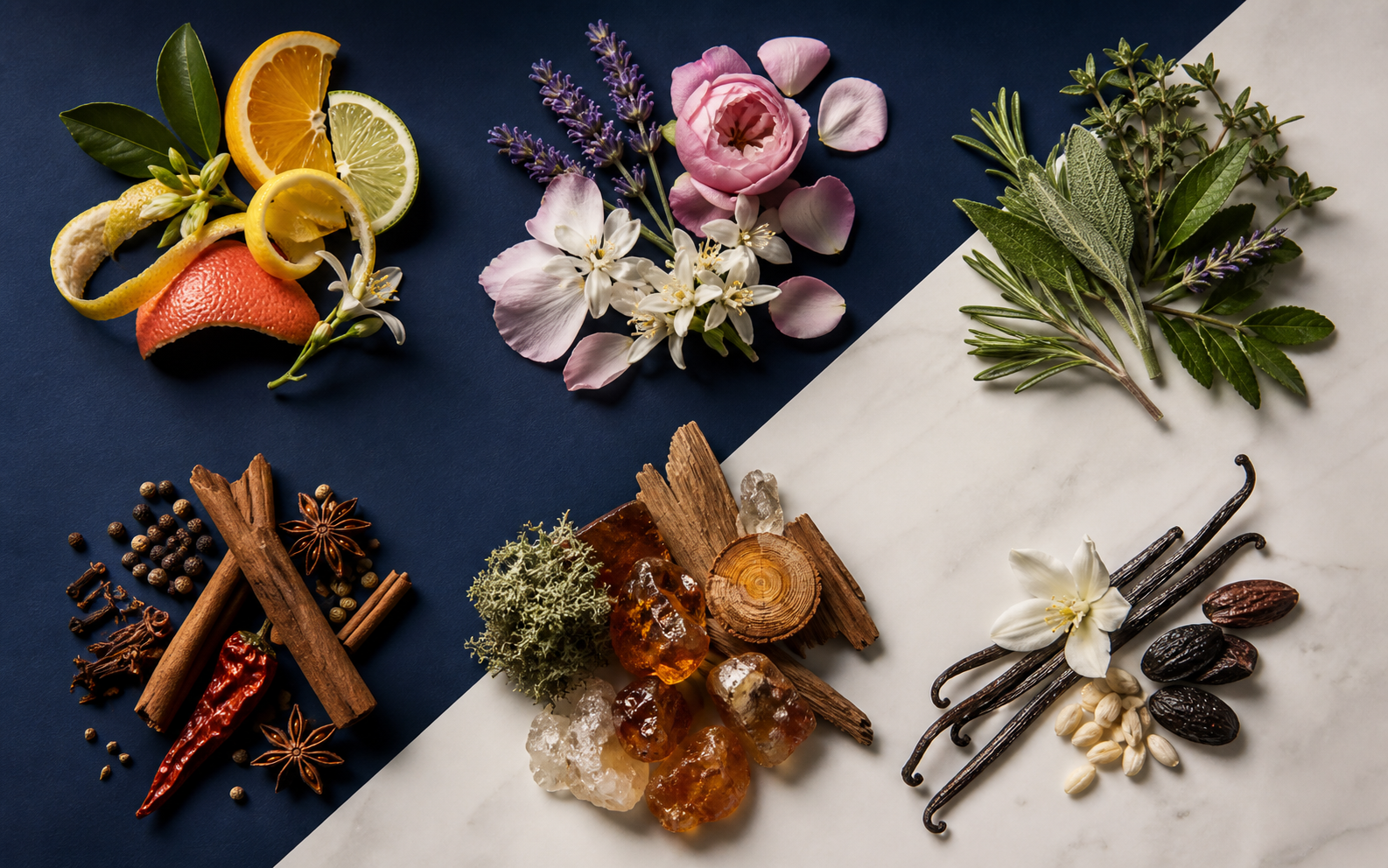
Brightness, cleanliness and energy.
From luminous to creamy.
Structure and duration.
Warmth and envelopment.
Practical map
How the main families are perceived
Citrus
Fresh, luminous and volátile. Ideal for heat, office wear and daytime use.
Floral
From transparent to opulent. It can range from clean neroli to intense rose or sensual jasmine.
Aromatic
Herbs, lavender and green facets. It feels polished, classic and energetic.
Woody
Cedar, vetiver, sandalwood or oud. It adds structure, dryness and elegance.
Amber
Resins, vanilla, spices and warmth. Enveloping, nocturnal and persistent.
Musky
Clean, skin-like, cottony or soapy. Works well when you want discretion.
Chypre
Bergamot, flowers, moss and woods. Elegant, contrasted and classically styled.
Gourmand
Vanilla, tonka, cocoa, praline, caramel or nuts. Sweet and comforting.
What to try
Perfume examples by fragrance family
The families are checked against brand information and Fragrantica as a community source for notes, accords and user perception.
Hermes Eau d’Orange Verte
Green, sparkling cologne for understanding classic citrus freshness.
Chanel N°5 Eau de Parfum
Abstract flowers with aldehydes, rose, jasmine and vanilla.
Yves Saint Laurent Libre Eau de Parfum
Lavender, orange blossom, musk and vanilla with a modern profile.
Le Labo Santal 33
Sandalwood, cedar, cardamom, iris and leather in a dry, recognizable signature.
Guerlain Shalimar Eau de Parfum
Bergamot, iris and vanilla for studying classic amber.
Mugler Angel Eau de Parfum
Praline, vanilla, patchouli and sweet facets with strong impact.
Byredo Blanche Eau de Parfum
Aldehydes, rose, sandalwood and musk with a clean-shirt effect.
Jo Malone Wood Sage & Sea Salt
Ambrette, sea salt and sage in a fresh coastal key.